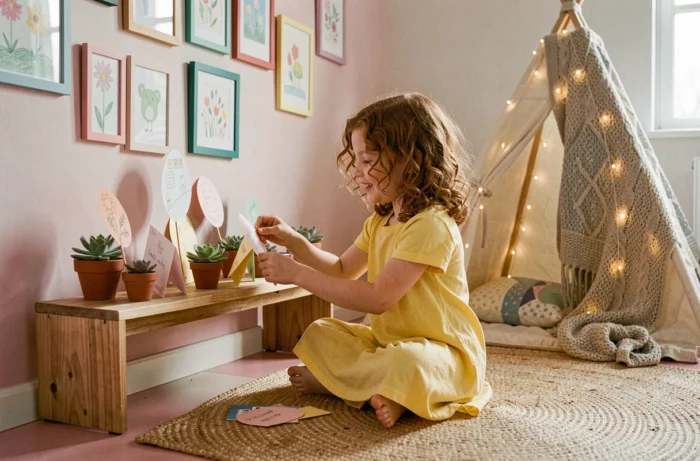
A child who refuses to tidy their room or who doesn’t really feel at home there, we all know this situation. Often, the problem doesn’t stem from the child’s character but from the layout itself: a space that doesn’t reflect them, poorly suited furniture, decor chosen without their input. Brightening up a child’s room is primarily about creating a place where they want to spend time, play, and sleep peacefully.
Air quality in a child’s room: the forgotten criterion of decor
When repainting a wall or installing new panel furniture, we rarely think about volatile organic compound (VOC) emissions. Paints, glues, flooring, and synthetic textiles can release formaldehyde and other substances for several weeks.
The City of Paris recommends thoroughly airing out after renovations and after installing new furniture, and favoring low-emission products, especially for a child’s room. In France, the relevant construction and decoration products carry the “Indoor Air Emissions” label, rated from A+ to C. Aiming for A+ for wall paint and flooring is a simple reflex that significantly changes the quality of the air breathed every night.
You can also discover the children’s universe of Frimousse and Coccinelle to find accessories and bedding designed for the comfort of the little ones, in addition to a healthy layout.
Personalized wall decoration: beyond classic wallpaper
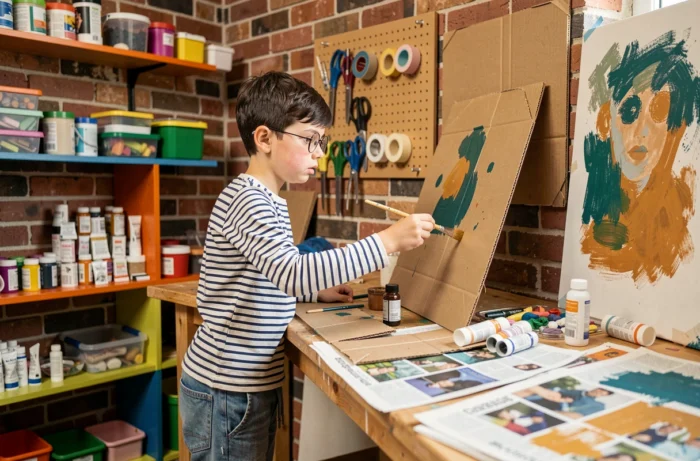
Competitors talk a lot about paint and stickers. We go further: involving the child in wall decoration transforms their relationship with the room. A wall painted with chalkboard paint, for example, becomes a space for free expression that the child claims over the weeks.
Evolving drawing gallery
Rather than framing one or two drawings and forgetting them, we install a magnetic strip or a taut wire with wooden clips. The child can hang and remove their creations whenever they want. The room evolves with them, without holes in the wall or permanent frames.
Decor themes chosen by the child
Animals, space, forest, ocean: the theme works better when the child chooses it themselves. We avoid permanent and costly wall murals. Interchangeable posters or repositionable washi tape allow for changing themes without repainting.
Feedback varies on this point, but a child who has participated in choosing the decor tends to respect their room better and feel more at home there.
Furniture fixation and safety: a decor angle too often ignored
A wardrobe that tips over, a poorly fixed shelf, a mirror leaning against a wall: these are real risks when the room also serves as a play area. Securing each tall piece of furniture to the wall with appropriate fixings (expansion plugs for concrete, specific plugs for drywall) is a step not to be skipped, even for a small locker unit.
- Place heavy items (books, game boxes) in the lower parts of shelves to lower the center of gravity of the furniture.
- Secure dressers to the wall even if they seem stable, as a child opening several drawers at once creates a lever effect.
- Check the fixings once a year, especially if the child is growing and starting to climb.
This is not just decor: it’s the foundation that makes all decorative choices possible without stress.
Designing the play area and sleeping corner in the same room
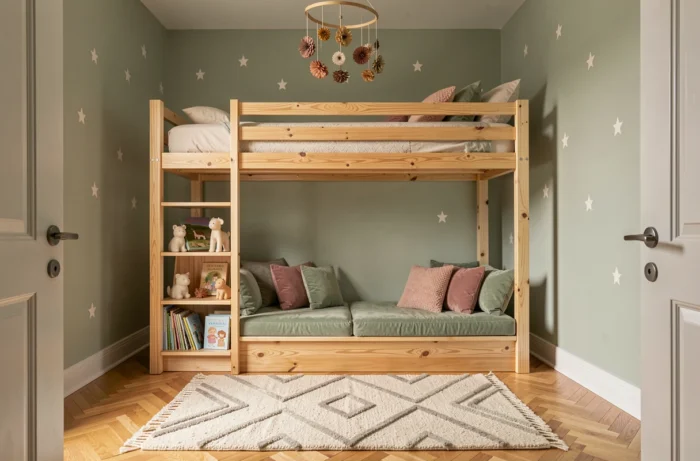
In most children’s rooms, there is only one space for sleeping, playing, and sometimes doing homework. Visually separating the areas without partitioning helps the child transition from one activity to another. A rug of a different color is enough to delineate the play area. A light curtain hung from the ceiling can isolate the bed from the rest of the room at bedtime.
Accessible storage and autonomy
A child tidies up more when they can reach their things on their own. We place toy bins at their height, use visual labels (photos or pictograms) to identify contents, and limit the number of visible toys. Regularly rotating toys (storing half and bringing them out a month later) renews interest without buying anything new.
Lighting suited to the moments
A single ceiling light is not suitable for all activities. We distinguish at least two light sources: a bedside lamp with warm light for bedtime rituals and brighter lighting for the desk or play area. Low-voltage LED string lights add charm while remaining safe, provided their compliance with current standards is checked.
- Ban halogen lamps in a child’s room: they get too hot and pose a burn risk.
- Opt for LED bulbs with a temperature between 2,700 and 3,000 kelvins for the sleeping area.
- Install a dimmer if the wall socket allows, to adjust the intensity according to the time of day.
Textiles and bedding for children: comfort and style every day
The choice of bedding goes beyond aesthetics. A cotton duvet cover with a sufficiently dense weight will be softer to the touch and more resistant to frequent washes than cheap synthetic fabric. For a young child, we prioritize textiles certified free from harmful substances.
Regularly changing covers according to the seasons or desires is the quickest and least expensive way to transform the atmosphere of a room. An animal-patterned set for winter, another more colorful for summer: the child finds a different room without any renovations.
Floor cushions, throws, and plush rugs complete the decor by adding comfort in the reading nook or play area. We choose machine-washable materials, because between snack crumbs and forgotten markers, ease of maintenance is not a luxury.
Designing a child’s room does not require a large budget. What makes the difference is thinking about safety and air quality before aesthetics, involving the child in choices, and opting for reversible solutions that follow their development. A repositionable wall, well-secured furniture, bedding that can be changed on a whim: the room remains lively, and so does the child.