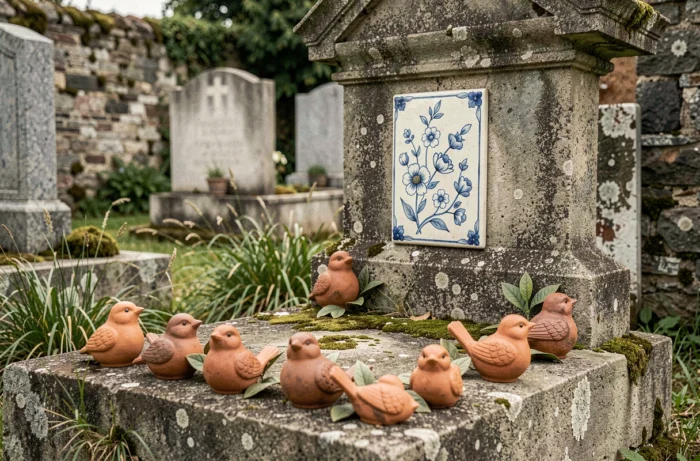
When you want to place a ceramic or ornament on a grave, the first constraint is not aesthetic: it is the cemetery regulations. Each municipality sets its own rules regarding the size, attachment, and placement of decorative objects. Ignoring this point risks having your ornament removed a few weeks after installation.
Municipal Regulations and Attachment of Funeral Ceramics on the Slab
Before choosing an ornament, check with the town hall what the cemetery’s internal regulations allow. Some municipalities prohibit any placement on the inter-tomb areas, which fall under communal public property. Others limit the height or weight of objects placed on the slab.
The distinction between placing an object and modifying the monument is rarely explained in catalogs. Placing a pot or a removable plaque is generally allowed in most cases. However, permanently attaching an element to a family monument (drilling, sealing, permanent gluing) may require the consent of the other holders or heirs of the concession.
Additionally, inscriptions added to a monument must be submitted for prior approval by the mayor. This point directly concerns engraved plaques and ceramic medallions bearing text. When considering an original funeral decoration for graves, it is better to anticipate this administrative process before placing an order.
Handcrafted Funeral Ceramics: Shapes and Firing that Withstand the Elements
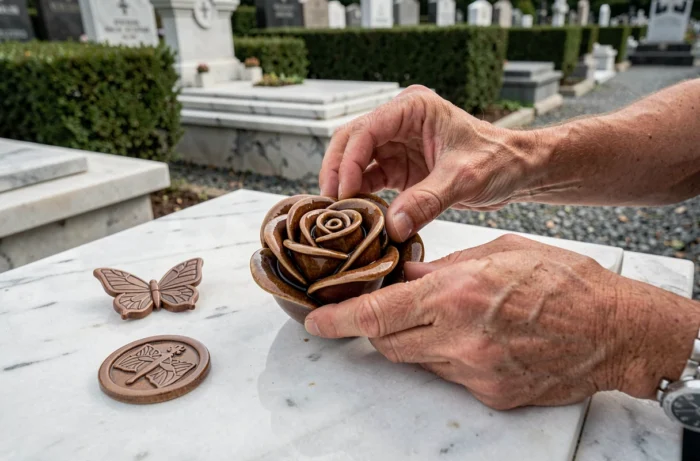
Funeral ceramics come in several families: bouquets, hearts, wreaths, crosses, arches, baskets, grave fronts. The choice of shape depends on the available surface on the grave and the desired style, whether modern or classic.
What differentiates a durable piece from an ornament that cracks at the first frost is the type of firing. A ceramic fired at high temperature withstands freeze-thaw cycles much better than a low-temperature glazed terracotta. For permanent outdoor use, stoneware or porcelain is preferred, as their almost zero porosity prevents water from seeping in and causing the piece to burst in winter.
Technical Criteria to Check Before Purchase
- The type of material: stoneware, porcelain, or earthenware. Earthenware remains fragile outdoors, and feedback on this point varies depending on the glazes used.
- UV resistance: a quality glaze retains its colors for several years without fading or yellowing.
- The provided attachment system: weighted base, stake, adhesive for natural stone or granite. A simply placed ornament can tip over in strong winds.
- The weight of the piece: a large ceramic bouquet may sometimes require a separate base to remain stable on a slightly sloped slab.
Specialized funeral shops offer ranges from individual roses to complete grave fronts covering the entire width of the burial site. There are also pieces made from reconstituted stone or high-density resin, which are less noble but easier to handle.
Customized Ornaments: Plaques, Medallions, and Engraving on Granite
Personalization is the main lever to move away from standardized ornaments. A black granite funeral plaque with laser engraving allows for the reproduction of a portrait, a landscape, a pet, or a personal motif with a precision that was reserved for expensive monuments a few years ago.
The ceramic medallion with an integrated photo remains the most common option for adding a face to a grave. The photo is printed on a ceramic support and then protected by a vitrified glaze. This process offers good durability over time, provided that the medallion is oriented to limit direct exposure to midday sun.
For the graves of animals or families attached to a deceased pet, plaques and ornaments representing dogs, cats, or birds are available in hand-painted ceramics or mass-dyed resin. These animal pieces can be fixed on a base or glued directly to the gravestone.
Maintenance of Funeral Ornaments: Responsibilities and Concrete Actions
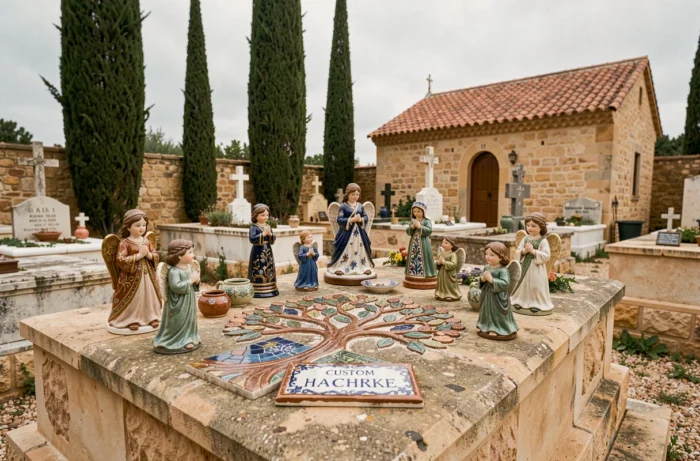
An ornament placed on a grave does not maintain itself. The family or heirs remain responsible for the maintenance of the concession, including the decorative elements added. The municipality only takes care of the common areas of the cemetery.
Cleaning a funeral ceramic is done with clear water, without acidic or abrasive products. A gentle sponge is sufficient to remove moss or pollution deposits. Avoid pressure washers that can detach a medallion or crack an old glaze.
Checks to Make During Each Visit
- Stability of the ornament: check that the attachments have not moved after a storm or frost episode.
- Legibility of inscriptions: a carved or painted text that fades can be restored by a ceramic artisan without replacing the entire piece.
- Condition of adhesive joints: a joint that is coming loose exposes the piece to theft or falling; it is better to redo it quickly with a sealant suitable for stone.
Some specialized associations offer burial maintenance contracts that include checking the ornaments. For families geographically distant, this is a practical solution that prevents discovering a broken ornament several months after the fact.
The choice of a funeral ornament thus combines three dimensions rarely addressed together: regulatory compliance, the technical durability of the material, and a realistic maintenance plan. A well-chosen and properly fixed handcrafted ceramic will last for years on a grave, provided that a few minutes of attention are given during each visit to the cemetery.