
Self-learning in electronics often comes with contradictory resources and non-linear pathways. The basics of direct current, long taken for granted, can sometimes be poorly explained in general textbooks. Accessing clear explanations on handling basic components can thus become a challenge for the curious.
Specialized platforms and online communities have, however, simplified the discovery of circuits, facilitating the understanding of fundamental concepts. The diversity of available resources today allows one to approach electronics according to their needs, without formal academic prerequisites.
Getting Started in Electronics: What You Need to Know Before Diving In
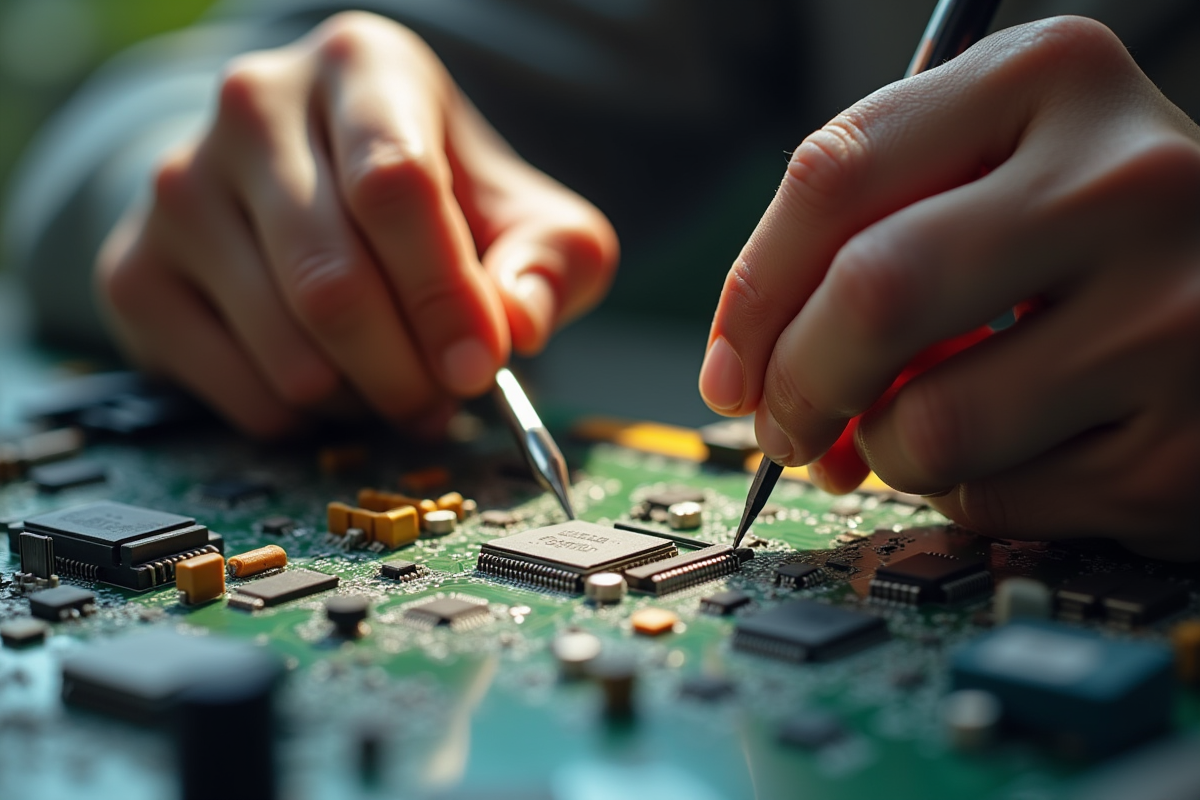
Entering the world of electronics is primarily about adopting a vocabulary, gestures, and a way of reasoning that are unique to it. Identifying the role and function of a resistor, capacitor, diode, or transistor is a crucial first step. These ubiquitous components lay the foundation for every circuit, from the most basic to the most ingenious. Familiarization necessarily involves experimentation: manipulating, trying, and observing how each element reacts in different configurations.
The alternation between theoretical understanding and practical testing makes all the difference. Reading is good, but bringing your readings to life is far more instructive. Assembling a simple circuit on a breadboard, connecting a few salvaged components, measuring a voltage, or observing the effect of a change in value: this is how lasting understanding is born. The concepts of voltage, current, or Ohm’s law then become tangible realities, not just formulas to memorize.
Faced with the multitude of possible topics, it is tempting to scatter one’s focus. To progress without losing track, it is better to build your learning around small, well-targeted projects. Here are a few examples that speak for themselves:
- Turning on an LED using a push button
- Creating a simple timer with a NE555
- Detecting light using a photoresistor
The use of programming and software simulators adds a valuable dimension. These tools allow you to anticipate the behavior of a circuit before moving on to the actual assembly. Gradually, the integration of microcontrollers or programmable modules ushers in a new era: interactive projects, automation, connected objects—everything becomes possible while reinforcing basic knowledge.
To stay on track with your projects, it may be wise to draw inspiration from methods used in other technical fields to organize your work effectively. Some popular guides, such as CACMDS for accessing my accounts, detail step-by-step planning, note-taking, and stage management. When applied to electronics, these methods reduce the risk of error, encourage questioning, and allow for better measurement of progress.
Where to Find Reliable Resources and Project Ideas to Learn While Having Fun
To move forward confidently, it is useful to know where to look for trustworthy online resources. The web is full of educational content, detailed tutorials, and explanatory diagrams created by enthusiasts or professionals. It is better to prioritize sites that combine technical accuracy with clarity in presentation, featuring well-designed diagrams and accessible explanations. Free online courses are available for anyone who wants to learn at their own pace, without time constraints, while benefiting from a progressive learning path.
Specialized forums and exchange spaces represent a significant asset. They provide the opportunity to ask questions, seek advice, or simply read ongoing discussions. These places are full of tips, solutions to concrete problems, and feedback that can sometimes be found nowhere else. For those learning alone, these communities act as silent partners, always ready to share their knowledge and encourage curiosity.
To get started, there’s nothing like accessible projects suited to your level. Connected weather station, discreet alarm, sunrise simulator: these concrete realizations highlight the main facets of hobby electronics. Some sites compile entire libraries of schematics, illustrated steps, and ideas for further exploration. The diversity of themes—robotics, home automation, embedded computing—fuels the desire to learn and gradually broadens one’s technical horizon.
Participating in contests, remote workshops, or collective challenges also offers a stimulating experimental ground. These initiatives promote exchange, mutual assistance, and the constructive confrontation of ideas. Through these shared projects, one gains insight into the role that electronics plays today in everyday life, from connected objects to automated systems. Who knows how far this technical curiosity will take you?