
Four different platforms to consult, just to track the schooling of a middle school student. This is not a dystopian scenario, but the reality experienced by many French families. Each academy imposes its own access modalities, without any real national coordination. Some institutions have opted for a single portal, while others remain mired in a mosaic of applications that do not communicate with each other.
This patchwork of solutions, whether local or national, ends up confusing everyone: parents, teachers, students. Yet, since 2020, several experiments aim to simplify the situation with unified interfaces, gradually deployed, to bring a bit of order to this digital chaos.
Digital educational tools: overview of essential platforms for students, parents, and teachers
Everything is moving fast; nothing really resembles the school of just ten years ago. The digiitalization of educational tracking has reset everything: families, staff, students, each is now a player in the digital services designed to lighten daily organization and make educational tracking more understandable. On the institutional side, the Ministry of National Education orchestrates the generalization of Scolarité Services, accessible via EduConnect or FranceConnect. Registrations, certificates, online report cards: each family accesses its procedures in a secure framework, compliant with GDPR.
The principle is simple: one identifier, one password, and direct access to the entire educational ecosystem. The single sign-on (SSO) system opens the door to digital workspaces (ENT): ENT ONE in primary education, Monlycée.net for Île-de-France, as well as other regional or local portals. Major platforms like Pronote (grades, absences, reports) or Moodle (online assignments, remote homework) communicate with this common base, accelerating the flow of information between the various actors in education.
Every department highlights its specific tools. For example, to navigate my college in Val-d’Oise, there are now practical and well-marked resources. Individualization is also progressing thanks to digital school reports (LSU, LSL), the Inclusive Pathway Booklet (LPI) for students with special needs, or the management of adapted systems: PAP, PPS, PPRE, GÉVA-Sco.
The digital transformation is clearly led by the Digital Education Directorate (DNE), which drives training, supports inclusion, and imposes new accessibility standards for a school that is both more agile and accessible. Digital referents, eRUN, RUPN, spare no effort to enhance everyone’s skills and transform daily practices.
How to easily access these services and integrate them into daily school life?
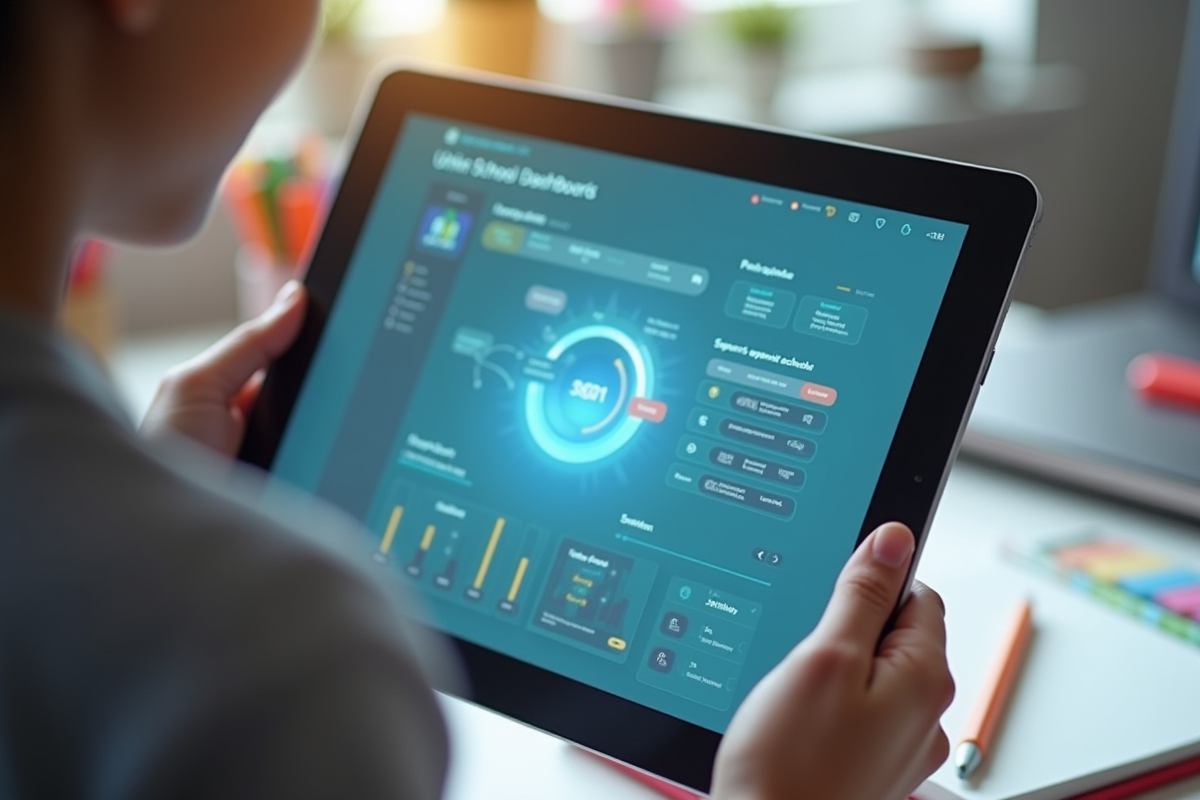
Access to educational digital services is designed to be immediate. It all starts with the provision of EduConnect identifiers to families, students, and teachers. Once connected from a computer, tablet, or smartphone, the interface provides access in seconds to all official documents, progress tracking, or useful procedures. The only imperative: not to lose anything and to keep your codes safe.
Over the weeks, usage becomes part of the routine. In primary school, ENT ONE and its mobile version ONE Pocket facilitate direct exchanges with teachers, feedback, access to notifications, and shared documents. In high school, teenagers and their families navigate Monlycée.net to check the homework calendar, report cards, absence history, and also interact with teaching teams in a very responsive manner.
Implementing and supporting the entire system remains a real collective challenge. Digital referents engage with each team and assist those who are still hesitant to take the plunge. Behind the screen, confidentiality remains non-negotiable: everything is designed to scrupulously respect the rules of GDPR, secure access, and ensure control over personal data throughout usage, whether one is ultra-connected or simply curious.
Let’s remember the essentials for the digital integration to take root and develop over time:
- Systematic provision of identifiers to each family, student, and staff member
- Compatibility ensured with all connected devices (computer, tablet, smartphone)
- Permanent support from digital referents in each institution
- Protection and rigorous management of data at every stage of the journey
The ambition for a single interface shared by all is not a pipe dream. So, tomorrow, will we see all families finally navigating on the same platform, without detours or headaches? The idea is gaining traction; perhaps the time has come to end the digital fragmentation of education.