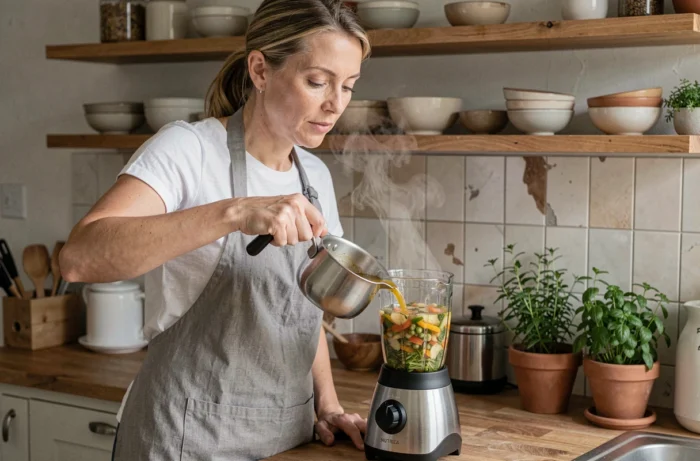
The NutriBullet is primarily a personal blender designed for mixing smoothies and cold preparations. The question of hot soup often arises because the NutriBullet range includes several models with very different capacities. Preparing hot soup with a NutriBullet is possible, but only with certain devices in the range and under specific temperature conditions.
Sealed cups or vented pitcher: the criterion that changes everything for NutriBullet soup
The confusion arises from the fact that the term “NutriBullet” refers to an entire family of devices. The personal models with sealed cups (NutriBullet 600, 900, Pro) are not designed to handle hot liquids. Their airtight sealing system prevents steam from escaping.
When a hot liquid is blended in a sealed container, the heat generates an internal pressure buildup. This pressure can cause the lid to pop off or force the cup out of its base. Users have reported splashes of burning liquid in such situations.
The NutriBullet Blender Combo, on the other hand, features a pitcher with a venting system designed to allow steam to escape during blending. It is the only type of configuration in the range that allows for working with hot ingredients. Using a NutriBullet device to make hot soup therefore requires checking that the model has this dedicated vented pitcher.
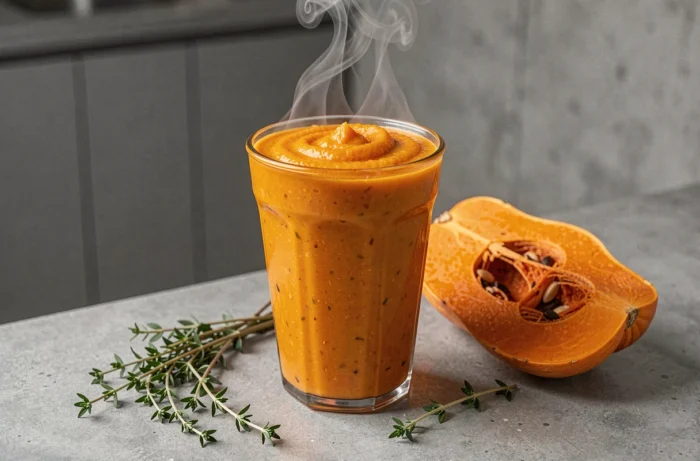
Maximum temperature for blending hot soup in a NutriBullet blender
Even with a compatible model, the temperature of the ingredients remains a parameter that must be strictly adhered to. Recent product guides for the NutriBullet Blender Combo indicate a recommended limit of around 80 to 82 °C. Hot liquid should not be poured directly into the pitcher.
In practical terms, this means that vegetables must be cooked beforehand (in a pot, oven, or steamer), then slightly cooled before being poured into the blender. The NutriBullet does not cook food: it blends it. Cooking remains a separate step.
What the NutriBullet does not do compared to a heated blender
A heated blender (like a soup maker) includes a heating element that brings the ingredients to a boil directly in the bowl. The NutriBullet, even in its Combo version, does not have a heating function. The motor’s power, which varies by model, is solely for blending.
The NutriBullet can produce a perfectly smooth velouté thanks to its steel blades and rotation speed, but it does not replace a heat source. To obtain hot soup, the sequence is always: cook first, blend next.
Documented risks related to hot liquids in a personal NutriBullet
Several lawsuits have been filed in the United States following incidents involving NutriBullets used with hot contents. The complaints described situations where the sealed cup exploded or detached from the base due to pressure, causing burns.
Personal models with sealed cups should never receive hot liquid. This point is mentioned in the user manuals, but it is often overlooked by users who consider their NutriBullet as a classic versatile blender.
- Sealed cups do not have any pressure relief valve, making blending hot liquids dangerous.
- The vented pitcher of the Blender Combo is the only safe option for warm to hot preparations (below the recommended threshold).
- Allowing a liquid to cool for a few minutes before blending significantly reduces the risk of splatter, even in a suitable pitcher.

Soup recipes suitable for NutriBullet blending
The NutriBullet excels in smooth-textured veloutés. Its blending power allows for very smooth results with tender cooked vegetables. Two recipes are particularly well-suited for this device.
Carrot Ginger Velouté
Cook chopped carrots in broth with grated fresh ginger until tender. Allow the mixture to cool slightly, then pour it into the vented pitcher of the NutriBullet Blender Combo. Blend in short bursts, then continuously until a smooth texture is achieved.
Zucchini Soup with Fresh Cheese
Cook zucchini with an onion in a bit of vegetable broth. After partial cooling, blend in the NutriBullet. Add a spoonful of fresh cheese after blending and stir. Fresh cheese incorporates better outside the blender to avoid a too frothy texture.
Which NutriBullet model to choose for making soups
The choice of model entirely determines feasibility. Personal NutriBullets (600, 900, Pro) are suitable for smoothies, cold sauces, and room temperature preparations. For soups, only the NutriBullet Blender Combo with a vented pitcher is recommended.
- The motor of the Blender Combo provides sufficient power to easily blend cooked vegetables.
- The large-capacity pitcher allows for preparing portions for multiple people, unlike individual cups.
- The presence of a removable cap on the pitcher lid allows for adding broth during blending while letting steam escape.
Blending hot soup with a personal NutriBullet with a sealed cup remains a bad idea, regardless of the recipe. The risk of splashing burning liquid is real and documented. For those who only own a personal model, the simplest solution remains to blend the soup after allowing it to cool to room temperature, then reheat it on the stove.