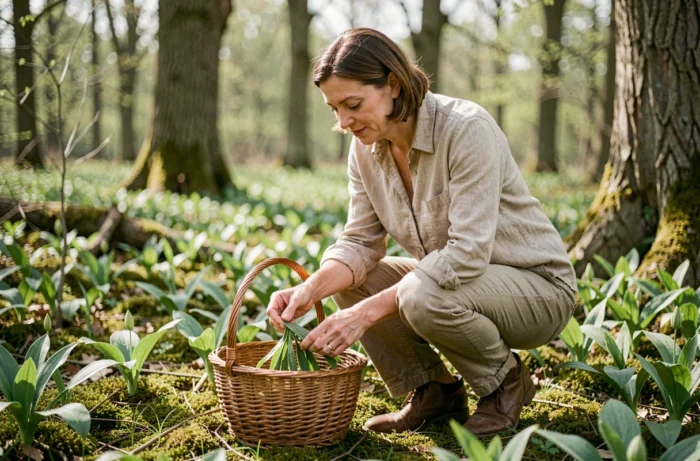
For several years, foraging for wild edible plants has been attracting renewed interest in France. Nettles, dandelions and wild garlic grow in meadows, woodlands and urban wastelands, where they are accessible to anyone who knows how to identify them.
However, harvesting them is subject to a specific legal framework and botanical considerations that general-interest guides rarely mention. The foraging calendar itself is shifting as a result of climate change, as recent phenological monitoring by Tela Botanica has shown.
Identifying wild plants: why photo apps aren’t enough
It’s tempting to photograph a leaf with your phone and rely on the result displayed. However, the French National Council of the Order of Pharmacists recommends consuming only species that have been positively identified and having any uncertain harvest checked by a specialist, rather than relying on an identification app. Although this warning was issued in relation to mushrooms, it applies just as much to wild plants.
Wild garlic (Allium ursinum) is distinguished by its characteristic garlic smell when crushed, but its leaves resemble those of lily of the valley and autumn crocus, both of which are poisonous. Confusion between these species is among the cases most frequently reported to poison control centers.
Learning from botanists and joining guided outings organized by groups such as L’Herbe sous le Pied are essential prerequisites before foraging on your own.
Identifying a plant means checking several features together: leaf shape and venation, how the leaves are arranged on the stem, smell, texture and habitat. None of these features is reliable on its own.
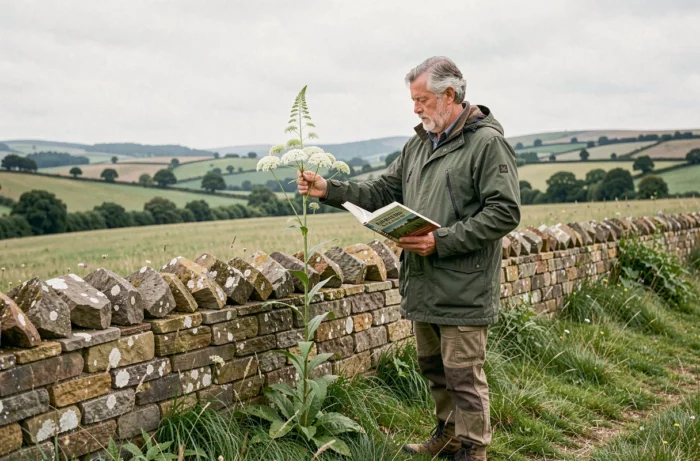
Foraging for wild plants and regulations: what the French Environmental Code says
Finding an edible plant doesn’t mean you have the right to pick it. Article L. 411-1 of the French Environmental Code prohibits harvesting protected species.
The location matters just as much as the species. In protected areas (nature reserves, core zones of national parks and biotope protection areas), picking any plant may be prohibited, even common species such as nettles or dandelions. On private land, you must obtain the owner’s permission before harvesting anything.
- Check whether the species you intend to pick is protected in the region concerned by consulting regional lists of protected species
- Make sure the foraging site is neither a protected area nor private property without permission
- Observe the limits on quantities allowed for personal use, which vary according to local regulations
- Avoid roadsides, areas treated with pesticides and the edges of conventionally farmed fields
An edible plant picked in the wrong place may be both legally off-limits and a health risk. Beginners often underestimate this double constraint.
A season-by-season foraging calendar: a guide that’s shifting
Traditionally, each season has its signature plants. Spring brings young nettle shoots, tender dandelion leaves and wild garlic in damp woodlands. Summer offers elderflowers, linden blossoms and meadowsweet. Autumn is a good time to gather berries (rose hips and sloes) and roots. The quieter winter months are ideal for harvesting wild chicory roots and a few evergreen leaves, such as ground ivy.
Nettles and dandelions in spring
Nettle (Urtica dioica) concentrates its nutrients in the young leaves at the top of the plant, which should be picked before flowering. Nettle leaves can be used in infusions and soups, or dried for later use. Dandelions (Taraxacum) can be harvested whole: use the leaves in salads, roast the roots and turn the flowers into jelly. These two species are among the easiest to identify and are widespread throughout France.
Flowers and aromatic leaves in summer
Linden and black elder produce fragrant flowers used in herbal teas and syrups. Wild mint and lemon balm, when growing outside gardens, can be identified by their smell and the square stems characteristic of the mint family (Lamiaceae).
Berries and roots in autumn
Rose hips, the fruit of the dog rose, and sloes are among the most sought-after wild berries in autumn. They can be made into jams or liqueurs.
Shifting seasons and phenological monitoring
These seasonal guides are no longer as reliable as they once were. Tela Botanica’s Floraison d’Altitude program uses weekly observations of blueberry bushes in several French mountain ranges to measure shifts between flowering and pollinator activity. Flowering time alone is no longer enough to predict the fruiting season, as ripening periods are becoming unpredictable.
Observers have suggested late frosts during flowering and droughts during ripening as possible explanations, but these hypotheses still need to be compared with complete weather data. For foragers, the practical takeaway is simple: observe plants at several stages (flowering, green fruit and ripe fruit) rather than relying on a fixed calendar.
When an edible plant shouldn’t be picked: knowing when to stop
An informed forager can correctly identify a plant and knows how it is used in cooking, as well as its benefits in infusions and dishes. But there are three situations in which you should leave it unpicked, even when you have identified the species with certainty.
The first is its protected status. Local populations of a species that is common elsewhere may be protected by a regional order. The second is the location: a treated field margin, roadside verge or protected area can make foraging either hazardous to your health or illegal.
The third is the remaining risk of confusion in a mixed stand: when an edible plant grows among toxic species that look similar, selective harvesting requires expertise that beginners don’t have.
In these situations, the most sensible approach is to note the location, take reference photos (but never use them as the basis for deciding whether to eat a plant) and return with an experienced botanist. Foraging for wild plants is about more than simply picking them. It requires ongoing learning, close attention to the terrain and the ability to walk away when conditions aren’t right.