1994 is not just a collection of iconic pieces. The year marks a break in the very mechanics of fashion, with the emergence of a distribution model that will restructure the streetwear market for the next three decades.
Supreme and the drop model: the commercial break born in 1994
The founding of Supreme in New York in 1994 represents a turning point that retrospective clothing reviews of this era almost systematically overlook. The brand does not just dress the skate scene of Lafayette Street: it introduces the principle of limited edition drops, a mechanism of organized scarcity that breaks with the classic seasonal logic of ready-to-wear.
This model transforms clothing into collectible objects. While traditional brands relied on constant restocking, Supreme imposes a limited release schedule that generates a queue, and then a secondary market. We observe here the shift from functional sportswear, inherited from hip-hop and basketball, to a culturally coded streetwear centered around skate, graffiti, and urban counterculture.
To better understand the clothing styles of 1994, one must place each piece in this context of transition between the street and the runway, between mass production and calculated scarcity.
Grunge and minimalism in 1994: two opposing forces on the same runways
The coexistence of grunge and minimalism in the same year is anything but anecdotal. It reflects a deep aesthetic fracture between two visions of clothing that directly confront each other in the spring-summer and autumn-winter collections.
The grunge aesthetic as an assumed anti-fashion
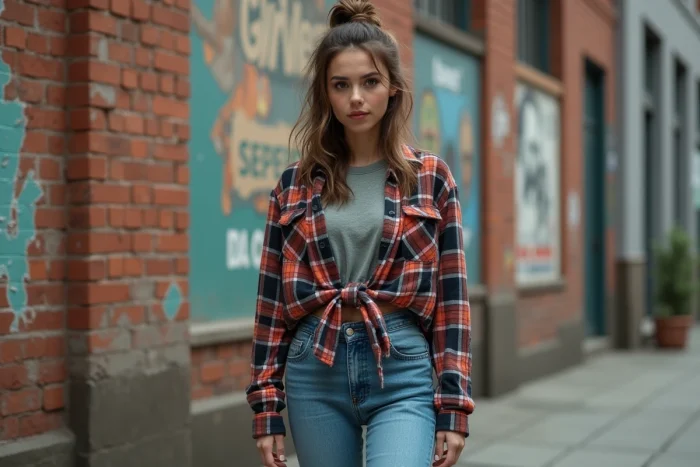
The open plaid shirt over a worn t-shirt, faded jeans, and work boots formed a deliberately degraded wardrobe. It was not a lack of means, but a rejection of the ostentatious luxury inherited from the 80s.
Grunge rejected the very notion of a “key piece.” The value of a garment lay in its lived appearance, sometimes bought already aged in thrift stores. The worn garment became the marker of authenticity, reversing the usual codes of new and premium.
Minimalism as haute couture’s response
On the opposite end, designers like Calvin Klein and Jil Sander offered clean silhouettes, neutral tones, and straight cuts without embellishment. The minimalism of 1994 did not seek discretion by default: it asserted that the cut alone justifies the price of a garment.
These two currents coexisted in the same magazines, sometimes in the same editorials. A Vogue reader could flip from a grunge shoot to a Calvin Klein campaign by turning a page. This constant juxtaposition blurred the hierarchies between popular fashion and prescriptive fashion.
High-waisted denim and urban sportswear: the defining pieces of 1994
Beyond aesthetic currents, certain pieces defined the everyday wardrobe of 1994 with remarkable consistency.
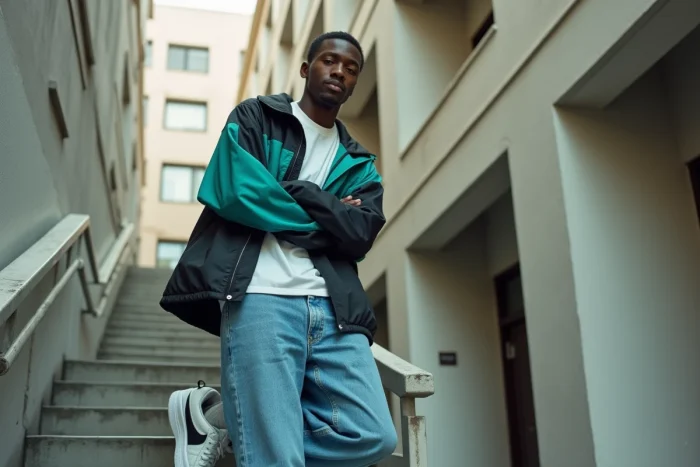
- The high-waisted jeans with a straight or slightly flared cut, worn by both women and men, formed the basis of most outfits. Its cut sought neither extreme slim nor extreme baggy, but a functional in-between.
- The oversized hoodie, previously confined to sportswear, entered the shelves of European department stores and became a layering piece worn both in the city and the suburbs.
- The leather jacket, borrowed from the codes of the 70s, returned in a less fitted version, often paired with a plain t-shirt and raw denim.
- Sport brand sneakers (Nike, Reebok, Adidas) left the sports field to establish themselves as everyday shoes, worn with outfits that were no longer athletic.
This constant blend of sporty pieces and city clothing defined the dress code of 1994 far more than any haute couture show.
Music channels and music videos: the fashion prescription circuit in 1994
Television music channels played a role in dissemination in 1994 that social media fills today. MTV and its European equivalents exposed millions of viewers daily to specific clothing choices, worn by artists whose influence extended far beyond the musical realm.
The music video functioned as a free and permanent lookbook. A hip-hop artist in oversized tracksuit or a grunge singer in a floral dress on Doc Martens conveyed a fashion message more effectively than any advertising campaign.
This prescription circuit short-circuited traditional fashion magazines. Teenagers no longer waited for September editorials to adjust their wardrobes: they picked up codes in real time, via a television screen. Previously obscure brands gained national, even international visibility by dressing the right artist at the right moment.
Legacy of 1994: what persists in today’s fashion
The drop system initiated by Supreme in 1994 remains the dominant model of contemporary streetwear. Brands like Palace, Off-White, or even traditional luxury houses have adopted this limited release schedule, proving that the mechanism born on Lafayette Street has permanently restructured the market.
The cyclical return of high-waisted jeans in recent collections is not a nostalgic coincidence. The cut of 1994, neither too fitted nor too loose, corresponds to a demand for comfort and versatility that the skinny jeans of the 2010s no longer satisfied.
The boundary between sportswear and city fashion, already porous in 1994, has simply disappeared. What was considered a bold mix thirty years ago now constitutes the dress norm for the majority of urban Westerners. 1994 did not invent all these pieces, but the year established the rules for their coexistence.