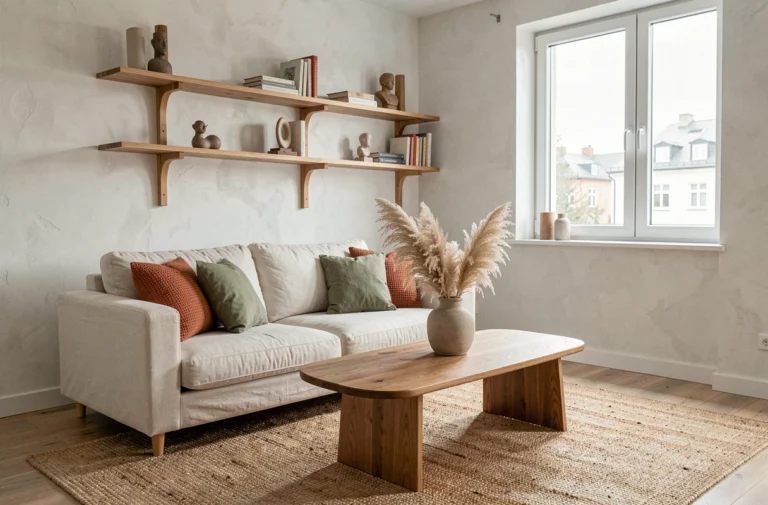
A sofa too deep for the living room, a light fixture that dazzles instead of illuminating, a storage unit bought on a whim that fits nowhere: we have all experienced at least one of these situations. Choosing the right equipment for your home is first about solving concrete problems before thinking about style.
Furniture, lighting, and decorative accessories work together. Neglecting the practical dimension condemns even the most beautiful objects to end up at the back of a closet.
Dual-function equipment for small urban spaces
In an apartment where the living room also serves as an office and sometimes a guest bedroom, each piece of furniture must justify its place on the floor. We’re not talking about clever gadgets here, but a structural choice: a piece of furniture with only one function wastes floor space.
The storage bench is the best example. Placed in an entryway or at the foot of a bed, it absorbs comforters, shoes, or bags while serving as seating. Coffee tables with hidden drawers serve the same role in the living room, swallowing remote controls, magazines, and charger cables.
You can find pieces like these, as well as narrow buffets suited for hallways and graphic hooks that dress up a blank wall, by browsing all the offers on the Deco Asaiss site in the equipment category.
- Entryway storage bench: seating, shoe storage, and a surface for placing keys and mail, all within less than a meter in width.
- Lift-top coffee table: it transforms from a coffee table to a work surface for a meal or a telecommuting session in seconds.
- Narrow buffet (less than 35 cm deep): it slips into a hallway or behind a sofa without blocking traffic, while offering real storage volume.
Indoor lighting: layer sources instead of relying solely on the ceiling light
The most common reflex in a living room or dining room is to plug in a central ceiling light and consider the issue resolved. The result: a flat light, often too harsh, that flattens the volumes of the room.
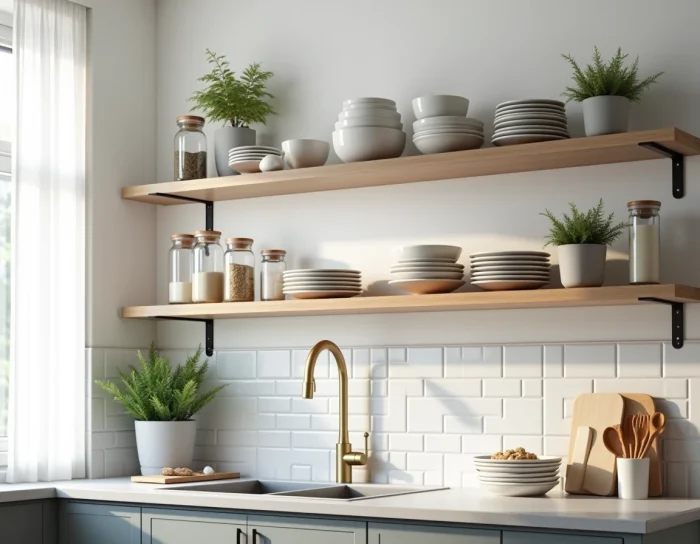
Layering three types of light sources radically transforms the ambiance. We distinguish general lighting (ceiling light or pendant), task lighting (desk lamp, reading light near the sofa), and accent lighting (wall sconces, LED strips behind furniture).
Choosing the right color temperature
The color temperature changes everything. A warm white bulb is suitable for the living room and bedroom. A neutral white works better in the kitchen or bathroom, where you need to see the true colors of food or your complexion in the mirror.
Opinions vary on this point, but many decorators recommend avoiding cool white in living spaces, which gives a clinical and unwelcoming feel. You can test two different temperatures in the same room before deciding.
Light fixtures as decorative objects in their own right
A tripod floor lamp, a rattan pendant, or a brass sconce do not only serve to illuminate. They visually structure a space and become focal points. It’s better to invest in a standout fixture for each area (living room, dining area, bedroom) than to multiply generic models.
Connected objects with decorative value: beyond the gadget
In recent years, several manufacturers have changed their approach. Thermostats, switches, and speakers no longer look like technical equipment hastily placed on a white wall. You can now find minimalist design switches, speakers disguised as sculptures, and TV frames designed to display artwork when the screen is off.
A well-chosen connected object replaces a decorative accessory instead of adding to it. A thermostat with a sleek casing, mounted at eye level in the entryway, draws the eye like a small frame would. A ceramic speaker placed on a shelf blends in among vases and books.
The trap is accumulation. Three visible connected objects in the same room recreate the “technical office” effect that you wanted to avoid. It’s beneficial to select one or two devices per living space and to hide the others (router in a closed cabinet, power strip behind the sofa).
Textiles and decorative accessories: the details that change a room
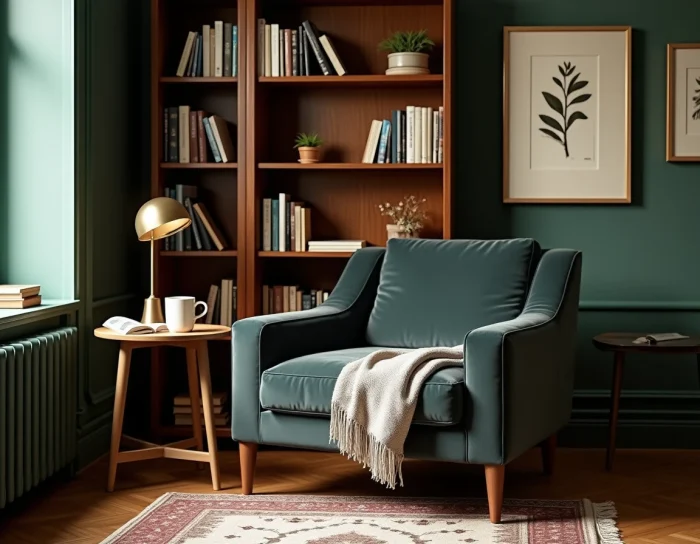
A living room can have the right furniture and lighting but appear cold without textiles. Cushions, throws, curtains, and rugs provide the layer of comfort that makes a space livable. Their main advantage: they can be changed according to the season to refresh the ambiance without a big budget.
Rugs and curtains: size before choosing the pattern
A common mistake is buying a rug that is too small for the intended area. In a living room, the rug should at least accommodate the front feet of the sofa and chairs. A model that floats in the middle of the room without touching any furniture visually shrinks the space.
For curtains, the rod should be fixed as high as possible, ideally just below the ceiling. Fabric that falls to the floor elongates the room. Curtains that stop halfway down the window give the impression of a compressed space.
Mirrors and frames to structure a wall
A large mirror placed opposite a window reflects natural light and visually enlarges the room. It’s one of the simplest and most effective pieces of equipment in terms of cost-impact ratio. Frame compositions, on the other hand, work better when arranged on the floor first before drilling, maintaining a regular spacing.
- Large rectangular mirror: to be placed on the floor against a wall or mounted opposite a light source to double the perceived depth.
- Frame composition: mix formats and orientations, but keep a consistent color palette among the frames.
- Vases and sculpted objects: grouping them in threes while varying heights creates a visual focal point on a console or shelf.
Enhancing an interior is not about a shopping list, but about the coherence between the chosen equipment and the actual use of each room. A well-sized piece of furniture, layered lighting, and a few suitable textiles are enough to transform a mundane space into a place where one feels good, without needing to overhaul everything each year.