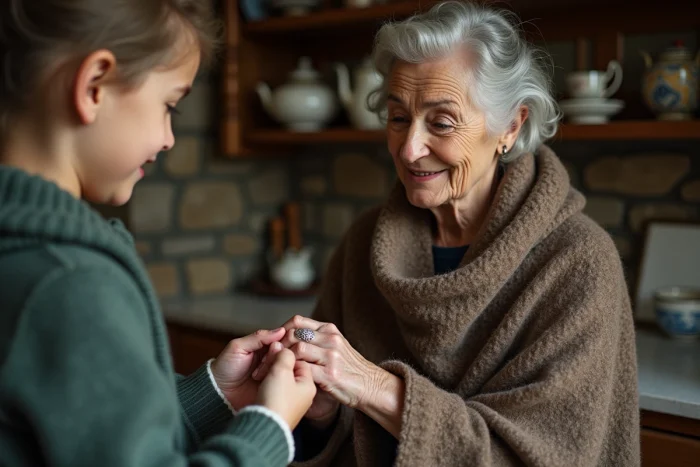
In Ireland, giving a Claddagh ring to a loved one is not just a sentimental gesture. The orientation of the ring on the hand radically changes its message, potentially signifying commitment, friendship, or singleness. However, this codified tradition does not have unanimous support across all Irish regions. Some descendants of Irish families still claim specific customs, often unknown outside the island. Behind this piece of jewelry lies a complex story that connects ancient symbols, local legends, and contemporary practices.
Claddagh: a fascinating story between legend and Irish tradition
It is impossible to mention the Claddagh ring without reopening, somewhere, the great book of the memory of Galway. This piece of jewelry is far from a simple ornament: it is firmly rooted on the banks of the fishing village of Claddagh, where the heart of Ireland already beat differently. Created in the 17th century by Richard Joyce, a goldsmith whose life took unexpected turns between kidnapping by pirates, slavery on foreign lands, triumphant return, and regained craftsmanship, it carries the fabric of a legend at the crossroads of History and personal quest. Through its two hands, heart, and crown, the Claddagh ring quickly establishes itself as a chapter of Irish identity: in the showcases of the National Museum of Ireland or the Victoria and Albert Museum, each piece bears witness to an art passed down, a heritage sometimes battered but always standing. During the vast waves of migration after the Irish Famine, the ring traveled in luggage, a precious witness to the bond with the homeland.
Why does the Claddagh persist, generation after generation? A few major reasons deserve to be highlighted:
- First, beyond the jewelry, the Claddagh ring claims an affiliation with the land of Connemara, carrying a collective history that is both unique and universal.
- Furthermore, the house of Thomas Dillon in Galway has been perpetuating traditional manufacturing since the 19th century: a guarantee of authenticity and artisanal quality.
To learn everything about the Claddagh ring, understand its roots and its role in Irish culture, one must delve into the gestures, stories, transmission, and unique attachment that this piece of jewelry evokes.
What do the hands, heart, and crown symbolize? Decoding the meaning of the Claddagh ring
Three motifs, never chosen at random, make up the Claddagh: the hands, the heart, the crown. One might think of a simple trio of ornaments, but each detail carries, holds, and reveals a philosophy that comes from afar.
Here is what each part tells, for those who take the time to observe:
- The hands embody friendship, trust, and belonging to a solid circle, a true silent language of complicity.
- The heart at the center, solid and bright, signifies true love, the depth of emotional or familial bonds.
- The crown reigns at the top, a symbol of unwavering loyalty and lasting commitment, the foundation of all promises.
Ancient Ireland did not resort to written oaths: each motif of the Claddagh was a living promise. Giving or wearing this jewelry means carrying, even in everyday gestures, all the strength of these values. Weddings, births, precious pacts: in Galway, the Claddagh circulates from hand to hand without ever exhausting, like a bridge between past and present. Choosing to wear it is to continue to keep alive the memory of the clan, the community, the unbroken vow.

Practical tips for wearing and choosing your Claddagh ring
It is impossible to overlook the wearing codes that circulate with the Claddagh ring: in Ireland, the way to wear it carries a message to decode. The direction of the heart, the chosen hand… everything has its meaning.
To identify the meaning given by the ring, here are the rules to know:
- Worn on the right hand, with the heart pointing towards the nail: this means the heart is free, the person open to a meeting.
- Still on the right hand, but with the heart turned towards the wrist: a story is unfolding, a relationship is being born or affirmed.
- On the left hand, heart pointing towards the wrist: the Claddagh transforms into a wedding ring, marking a deep commitment, engagement, or marriage.
Choosing your ring involves more than aesthetics: it is better to prioritize a Claddagh ring with guaranteed authenticity, produced in respect of ancestral forms. Silver, yellow gold, white gold: each metal brings its nuance, sometimes enriched with precious stones or delicate engravings. While men’s models display clean, sober lines, the feminine versions often stand out for their delicacy or a carefully crafted detail.
Giving or wearing a Claddagh ring is to commit in one’s own way: a pact of friendship, a sealed fidelity, or a promise of love, each ring whispers a story. This piece of jewelry continues to facilitate dialogue between past, present, and future, without words, just at the tips of the fingers, a silent witness of a heritage ready to be passed on for a long time to come.